Starting an Airbnb in Ann Arbor
Here’s everything you need to know about how to set up a short-term rental safely, profitably, legally, and reduce your active W-2 income taxes.

Disclaimer- No part of this was written by a third party or a robot.
“Your profits reflect the success of your customers.”
What is Considered a Short-Term Rental in Ann Arbor?
Ann Arbor defines a short-term rental unit as one that is rented for 30 consecutive days or less. See their short-term rental description page here and further information regarding how Ann Arbor regulates short-term rentals here.
Currently, there are four main ways a dwelling can be used as a short-term rental in Ann Arbor.
1. You owned an existing short-term rental before the most recent update to city regulations on short-term rentals. These were “grandfathered” in. These grandfathered short-term rentals are transferrable to new owners.
2. You buy a dwelling in a mixed-use or commercially zoned area for the purpose of using it for short-term rentals.
3. It is your primary residence and you want to rent part of your house to a short-term rental guest.
4. It is your primary residence and you want to rent all of your house to a short-term rental guest.
5. A bonus category short-term rental could be an RV that you let park in your driveway for game day as Ann Arbor Public Schools just said they would no longer allow RV’s to park at Pioneer High School for game day or rent out one you already own.
Ann Arbor currently allows short-term rentals. Just make sure you follow the rules!
Where Are Short-Term Rentals Located In Ann Arbor?
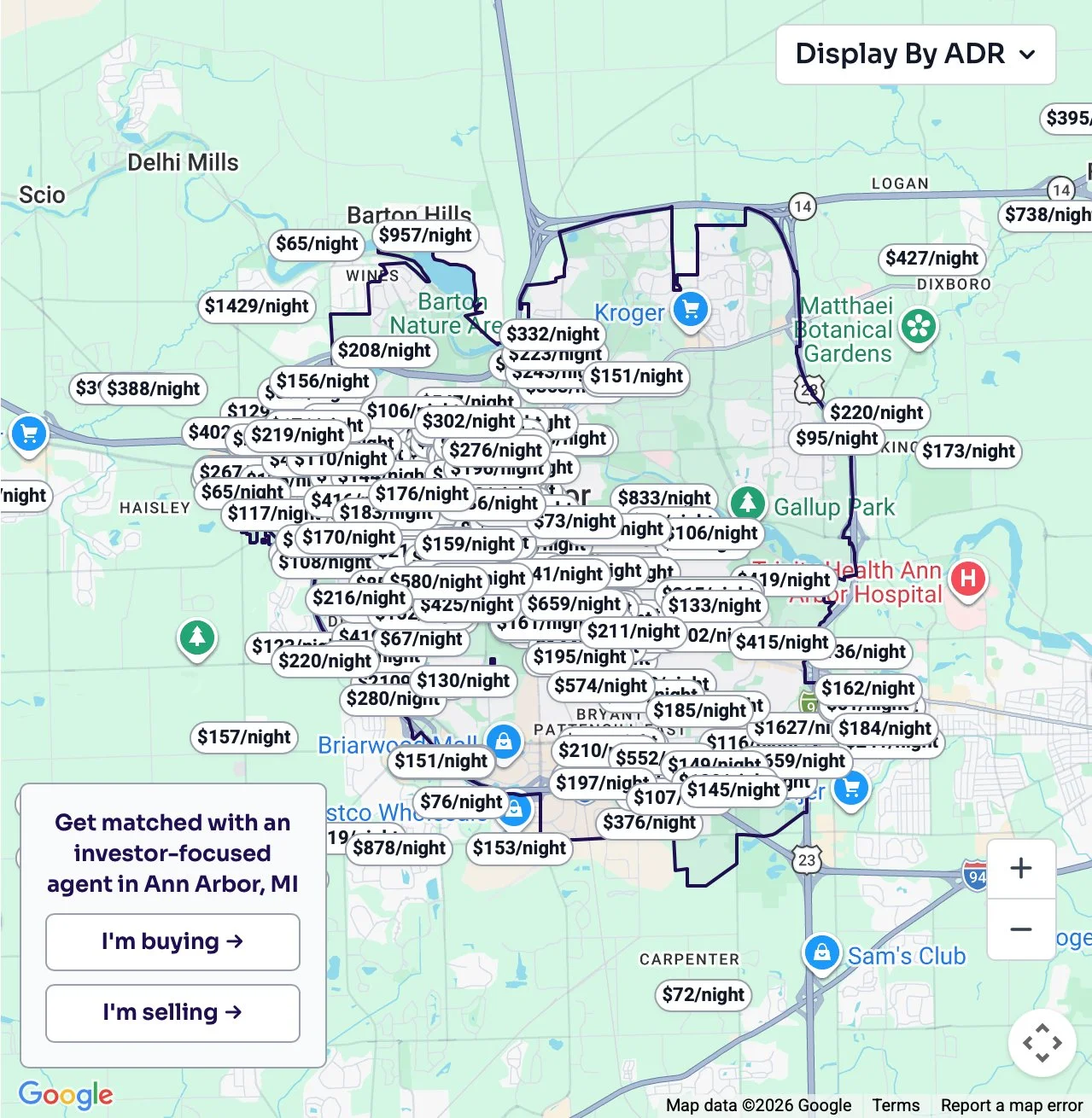
Short-term rentals in Ann Arbor as of the date of publication. Source: Rabbu.com
Tips to Offering Safe, Profitable and Legal Short-Term Rentals in Ann Arbor
Here are 5 tips to help you have the best experience with short-term rentals in Ann Arbor and licensing guidelines.
-
-First, make sure it fits one of the categories of legal short-term rental dwellings outlined above by the City of Ann Arbor. RV’s are not real property and may be outside the category of the real property described as short-term rentals requiring a license—confirm this with the City.
-Second, apply for a license from the City here to use the dwelling as a short-term rental. Short-term rentals that are not primary residences will also need to be inspected and pass housing code requirements.
-Third, make sure you apply for a Michigan Lodging Use Tax License as described here which is a 6% tax on gross rents and all fees charged for lodging less than 1 month in duration. Some platforms collect this for you.
-Fourth, if you use a third party platform to book your short-term rental with guests like airbnb, Vrbo, booking.com you have to register and follow their guidelines as well and pay the associated fees.
-
Yes, third party booking sites, co-hosts and property managers do offer host insurance. Be sure to read the terms carefully.
However, you probably want to make sure your homeowners policy covers the short-term rental activity also.
If you are just renting out a part of your house as a short-term rental, you may not need specific insurance for that as you are living in the house also—check with your policy provider.
A short-term rental where you are renting the whole house requires a short-term rental policy for the house. Most homeowners policies will not cover whole house short-term rentals. Call around for differences in policies and rates.
-
Useful sites for researching short-term rental markets are airdna.co and Rabbu.com.
You can find a plethora of information on active short-term rentals in the Ann Arbor area.
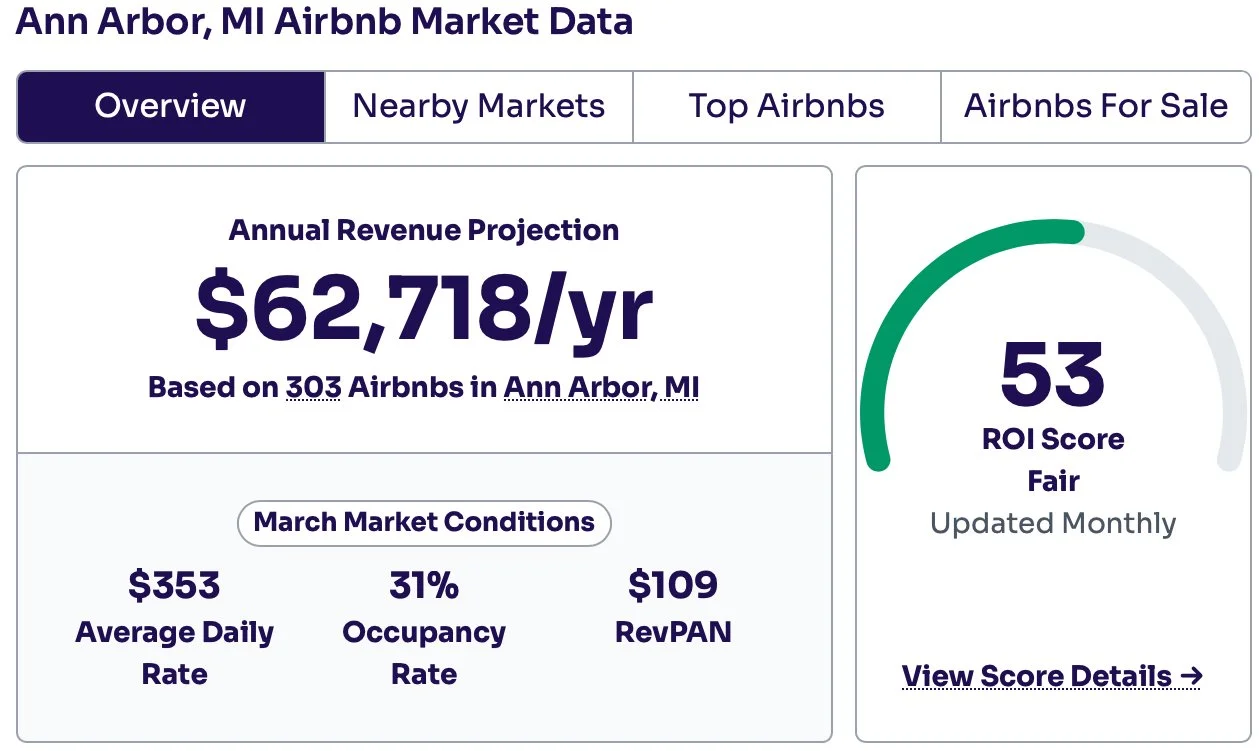
-For example, at the time of writing, the average daily rate is $353 in March..
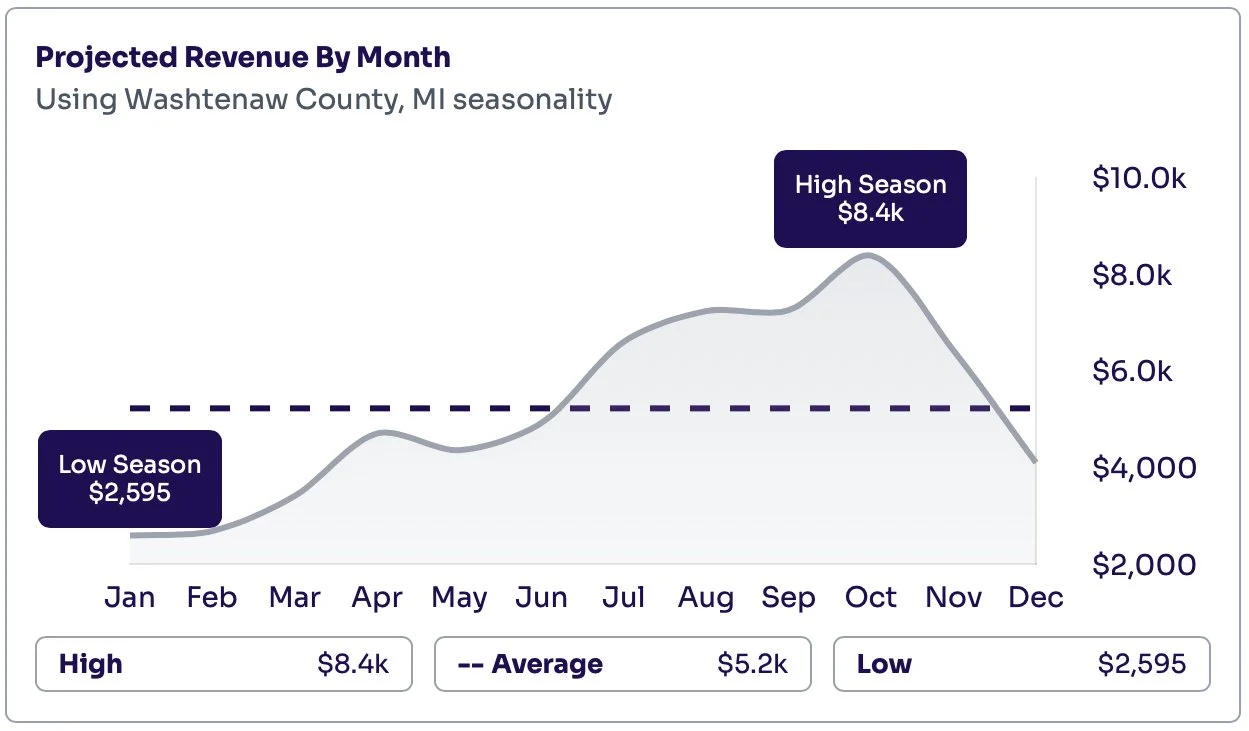
-October is typically the best month for bookings with an average projected monthly revenue of $8,400.
-January is the slow season with an average projected monthly revenue of $2,595.
-Average annual revenue in Ann Arbor is projected at $62,718.
-Rabbu’s return on investment (ROI) score for Ann Arbor is 53 (out of 100).
-83% of short-term rentals are whole house rentals.
-17% are private room short-term rentals
-Rentals from platforms is 67% from airbnb and 13% from Vrbo with 20% from both.
-We partner with a statewide short-term rental property manager that can give us on the ground data for nearby properties to compare to the performance data online. They offer a menu of services from full service to limited depending on your needs and preferences. You can also look at working with a co-host.
-An interactive map of short-term rentals in Ann Arbor on Rabbu.com shows that most rentals are located in downtown and you can even click on each one and see daily rates, pictures and descriptions.
Make sure you do your market research in your specific part of downtown and think about your proximity to the stadium for game day rentals.
-
There are services that will help you list your property on all the major short-term rental platforms, manage guest issues, restock consumables and handle cleaning and make sure your reviews stay high as that is an important part of the business.
We partner with a statewide short-term rental property management company that will be involved with analyzing the property before you buy using their experience with nearby properties and online performance data, help you think about maximizing the average daily rate, occupancy, and property value, and manage the property to keep reviews high and property performing at a high level. They offer a menu of services from full service to limited service based on your needs and preferences.
You can also consider using a well reviewed co-host service.
-
Think about having rules for your house for the guests posted online and in a book in the house for guests that are enforceable and enforced.
You can also include information on local attractions and dining but make sure the house rules are clear and the guests acknowledge them before their stay.
Exterior cameras are also a good precaution if you are not staying at the house also.
Some general requirements for short-term rentals with the City of Ann Arbor are:
A short-term rental cannot exceed the allowed occupancy for that unit.
All sleeping areas must be habitable and safe.
The short-term rental license number and maximum occupancy must be included when advertising the property.
A short-term rental host is responsible for all issues related to guests and enforcement complaints.
Non-owner occupied properties must have a valid Certificate of Compliance before applying for a short-term rental license.
Short-term rental licensing requirements with the City of Ann Arbor:
You apply online for a short-term rental license through the city’s STREAM site under the license tab.
You must pay the $500 fee before the application will be reviewed.
Processing of application can take up to 21 days.
The application fee includes police, treasury, customer service, and rental review. You will receive a certificate to post onsite once approved.
Properties with several units will need a separate license for each unit.
Each license to be renewed on an annual basis.
Short-term rental licenses can be revoked.
The city of Ann Arbor allows short-term rentals but you have to follow the rules and stay compliant.
“Projected, high season, monthly revenue is $8,400 in October with average annual revenue of $62,718/yr in Ann Arbor.”
Source: Rabbu.com
Source: Rabbu.com
How You Can Reduce Your Active Income Taxes from Owning Short-Term Rentals in Ann Arbor
Investment real estate has its traditional advantages of providing cashflow and tax advantaged depreciation.
Short-term rentals provide and additional advantage if the owner materially participates with enough hours each year managing the property as the IRS then treats it as an active investment. This is a great article that explains this in detail. This allows the owner to reduce their W-2 or active income with the depreciation from the property.
There are ways to accelerate the depreciation even more with things like bonus depreciation, which is currently a tax thing, for things like carpet, furniture, and hot tubs which short-term rentals are typically loaded with.
Additionally, an owner can do a cost segregation study where all the things that can be depreciated faster can be pulled forward creating a big income tax reduction for your W-2 and active income.
Some investors not only reduce their income taxes but they strategically do this as well when their children are college age to help with college financing.
Please consult your tax advisor for specific details or we can refer you to a knowledgable tax advisor.
How Can a Real Estate Professional Help You With Short-Term Rentals?
A real estate professional can help you understand the rules of having a short-term rental in Ann Arbor and help analyze if a property would be allowed as a short-term rental and its potential profitability which is different for each property.
If looking to purchase a property to use as a full time short-term rental they can identify areas that would be zoned to allow full time short-term rentals in the city or properties that are already full time short-term rentals and allowed to continue that way for the new owner.
Finally, they can help you run a short-term rental safely, profitably, and legally.
““I would 100% recommend Jeff from Arbor Advising to anyone in the area. My husband and I came to Jeff looking for our first short term rental property. We were eager to get started but I had a long wish list. Jeff helped us navigate the marketplace quickly and even connected us with a few key people in his network to vet properties for us. We’re so glad we partnered with Jeff and we hope to do so again as we grow our portfolio.””
FAQ
1. Is it legal to own a short-term rental in Ann Arbor?
Yes it is. It just needs to be an existing short-term rental or in the correct zoned area unless it is your primary house.
2. Can you reduce your W-2 or active income taxes with short-term rentals?
Yes, if you document enough hours to materially participate in helping with the property, you can reduce your W-2 or active income taxes by accelerating the depreciation.
3. How can a real estate professional and short-term rental property manager help you?
They can help you identify profitable properties and locations looking at performance data and suggest how to make improvements to the property and income potential. A property manager can help manage the property and keep the reviews up and listing optimized for guests.
Bottom Line, How to Offer Short-Term Rentals in Ann Arbor Safely, Profitably, Legally, and Reduce Your Active W-2 Income Taxes.
While the profit potential is real and the City of Ann Arbor allows short-term rentals, make sure you follow the rules and protect yourself and your property.
Apply for a short-term rental license with the City for your property and a Michigan Lodging Use Tax License with the state or make sure the platform you use collects this.
Many short-term rental platforms and cohosting services offer host protection. Make sure your own homeowners policy covers the short-term rental activity you intend to engage in as well.
Do your market research and study your competition in the city for short-term rentals.
Short-term rentals can be an excellent way to reduce your W-2 or active income taxes if you materially participate with enough hours helping run the property.
Consider using a property management company or co-host service to help you manage guests, cleaning and restocking, bookings and keeping your reviews and ratings high to attract more guests.
Finally, make sure you have rules for guests for the house that are enforceable and enforce them.
To Your Success!
Arbor Advising has a passion for helping people buy, sell and invest in real estate. We believe real estate is the best way to create passive income, grow your wealth and provide inflation adjusted returns in retirement with fantastic tax benefits.
Want to learn more? Contact us.
Disclaimer:
Always speak to your CPA, investment advisor and attorney before making any investment decisions. Past performance does not guarantee future returns. Arbor Advising seeks to educate and does not endorse any specific product, service or investment.